10 Years of Passenger Growth & Social Value (2015–2025)
Communities Connected Through Rail
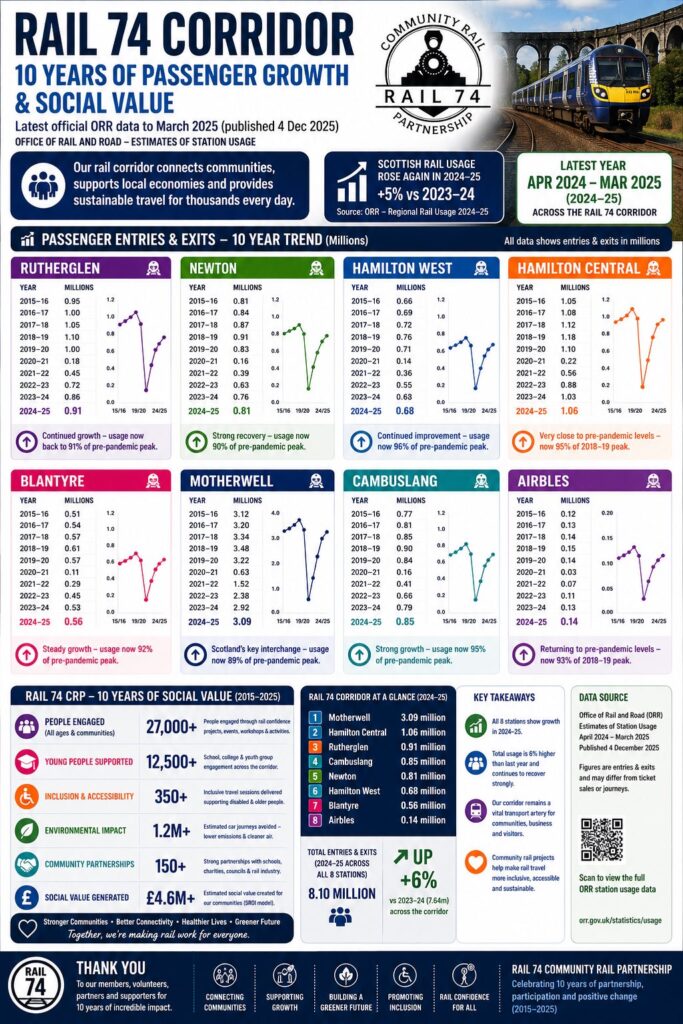
For the last decade, Rail 74 Community Rail Partnership has worked alongside communities, rail partners, schools, volunteers, and local organisations to help make rail travel more accessible, inclusive, sustainable, and community-focused across the Rail 74 corridor.
New official data published by the Office of Rail and Road (ORR) for 2024–25 highlights the continued recovery and growth of local rail usage across our line, showing the importance of community rail in supporting people, places, and local economies.
Passenger Growth Across the Corridor
The Rail 74 corridor covers stations including:
- Rutherglen
- Cambuslang
- Newton
- Blantyre
- Hamilton West
- Hamilton Central
- Airbles
- Motherwell
Together, these stations recorded more than 8.1 million passenger entries and exits in 2024–25, representing a 6% increase on the previous year.
Several stations are now approaching or exceeding 90–95% of their pre-pandemic passenger levels, showing strong confidence in rail travel returning across Lanarkshire.
2024–25 Passenger Highlights
- Motherwell: 3.09 million passengers
- Hamilton Central: 1.06 million passengers
- Rutherglen: 0.91 million passengers
- Cambuslang: 0.85 million passengers
- Newton: 0.81 million passengers
This growth reflects not only increased travel demand, but also the importance of local rail connectivity for work, education, healthcare, leisure, and community life.
More Than Passenger Numbers
Community rail is about far more than statistics.
Over the last 10 years, Rail 74 CRP has focused on ensuring the railway works for everyone — especially people who may face barriers to travel, confidence, or inclusion.
Our Social Impact (2015–2025)
Over the last decade Rail 74 CRP has delivered:
- 27,000+ people engaged through events, workshops, travel confidence projects, and community activities
- 12,500+ young people supported through school, youth, and educational engagement
- 350+ inclusion and accessibility sessions supporting disabled people and communities
- 150+ community partnerships developed with schools, charities, councils, rail industry partners, and local groups
- 1.2 million+ estimated greener journeys helping encourage more sustainable travel choices
- £4.6 million+ estimated social value generated using recognised social value measurement models
Inclusion at the Heart of Our Work
One of the partnership’s key priorities has been improving accessibility and inclusion within rail travel.
Projects delivered across the corridor have included:
- Supported rail confidence journeys
- Autism-friendly travel initiatives
- Accessible station guides
- Youth engagement and railway heritage projects
- Safety and travel awareness sessions
- Community environmental activities
- Partnership working with schools, charities, disability groups, and transport providers
Programmes such as Travelling Classrooms, Tracks to Inclusion, and Inclusivity Matters have helped hundreds of people feel more confident using public transport while creating stronger connections between communities and the railway.
Supporting Sustainable Travel
Rail travel remains one of the most sustainable forms of public transport, and increasing local passenger numbers contributes to:
- Reduced congestion
- Lower emissions
- Better local connectivity
- Improved access to jobs and education
- Stronger local economies
Rail 74 CRP continues to promote greener, healthier, and more connected communities through community-led rail initiatives.
Looking Ahead
As Rail 74 CRP marks 10 years of activity, the partnership remains focused on:
- Growing inclusive rail travel
- Supporting community wellbeing
- Encouraging sustainable transport
- Strengthening local partnerships
- Helping people feel confident and connected through rail
The continued recovery in passenger numbers across the corridor shows that local rail remains vital to the future of our communities.
Data Source
Passenger figures are based on official Office of Rail and Road (ORR) Estimates of Station Usage data for April 2024 – March 2025, published December 2025.